
June 11, 2026
Are you dreaming about wide-open space in Mountain Home, but wondering what really comes with buying large acreage? In this part of the Texas Hill Country, land can offer privacy, long views, and room to build a legacy, but it also brings practical questions about access, water, utilities, terrain, and long-term use. If you want to buy with confidence, it helps to understand how acreage here works before you fall in love with a tract. Let’s dive in.
Mountain Home sits in the Texas Hill Country, where the land itself shapes the buying process. Texas Parks and Wildlife describes this region as Edwards Plateau country with rolling to hilly terrain, springs, limestone aquifers, steep canyons, stony hills, and coarse-textured soils. That means a large tract here is rarely just a home site.
When you buy acreage in this area, you are often evaluating how the land functions over time. Buyers may look at a property for recreational ranching, grazing, hunting, wildlife management, or long-term stewardship, along with residential use. Texas Parks and Wildlife also notes that the Hill Country contains at least 407 game and nongame species, which helps explain why wildlife and habitat matter so much in local land decisions.
This setting also creates beauty and complexity at the same time. A dramatic ridge, spring-fed draw, or wooded canyon may add value to your experience of the land, but each one can also affect access, building plans, runoff, and maintenance.
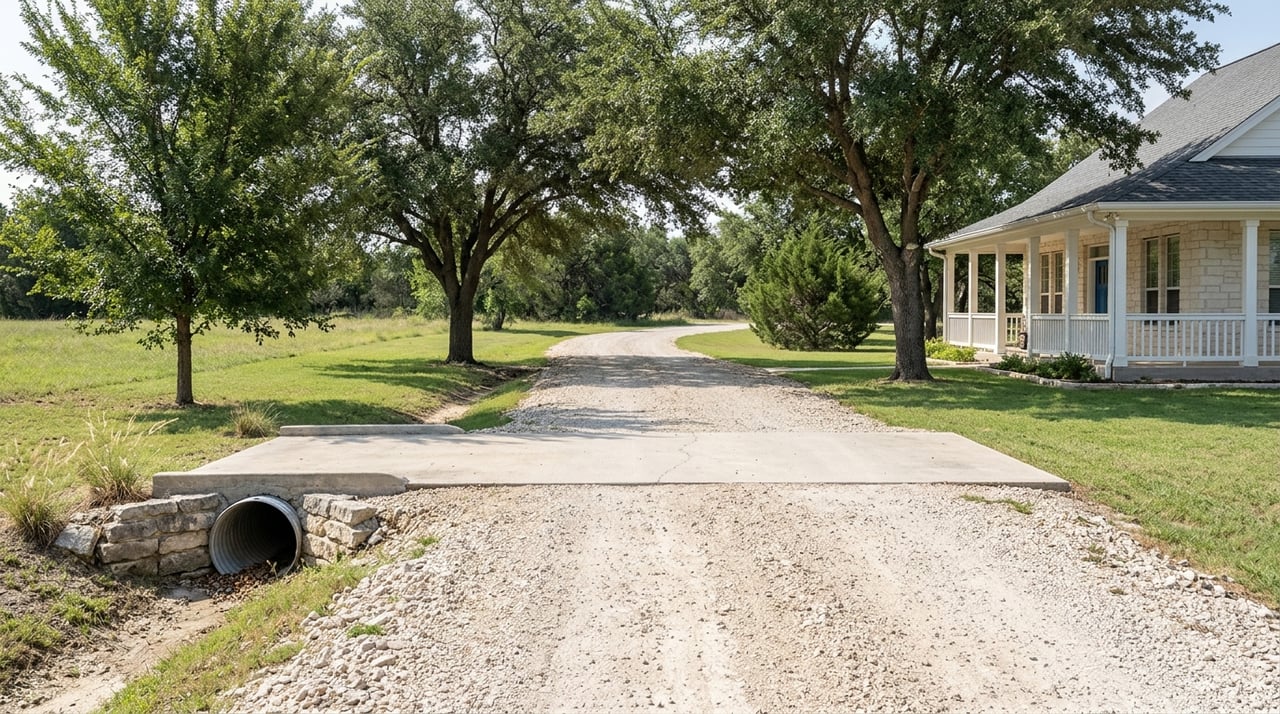
On large acreage, access is one of the first things to verify. In Kerr County, the key question is whether the tract is reached by county road, state highway, private road, HOA road, or a recorded easement. You do not want to assume access is simple just because a road appears to touch the property.
Kerr County says county-maintained roads are marked with a green street sign with no red stripe. The county also states that new or modified driveways on county-maintained roads require a county permit, while driveway work on state highways is handled through TxDOT. That matters because driveway placement can affect drainage, safety, and future use.
Right-of-way is just as important as the road itself. Kerr County notes that every county-maintained road has a right-of-way, but the width can vary based on the road’s history and the surrounding landscape. The county also states that only a surveyor can provide the exact location, so your survey becomes a key part of due diligence.
A large tract can feel unrestricted at first glance, but paperwork often tells a more complete story. Utility easements, recorded access easements, setback lines, deed restrictions, and plat restrictions can all shape what you can do with the property. These issues can affect building locations, road placement, fencing plans, and future improvements.
Kerr County also says there are no zoning restrictions imposed by its subdivision rules and no building permits or certificates of occupancy at the county level. Still, that does not mean there are no rules. Deed restrictions, plats, and other agency requirements may still apply depending on the tract.
If you think you may want to divide the land later, this should be part of your review from the beginning. Kerr County states that subdivision rules apply to tracts outside the city limits of Kerrville and Ingram unless platting authority is waived by the court. A property that works well as one tract may not split as easily as you expect.
In the Hill Country, water should never be treated as an afterthought. Kerr County requires water-well permits through the Headwaters Groundwater Conservation District, and that process is a major part of rural land ownership. If a tract has an existing well, you will want to confirm its status, records, and any related permit or registration details.
Headwaters GCD says it was created to protect underground water resources in Kerr County and that it registers and permits wells drilled in the county. It also tracks drought conditions, well levels, and pumping. Its forms and procedures show separate processes for exempt wells used for household, domestic, and livestock purposes, as well as permitted wells and ownership changes.
In practical terms, this means you should ask detailed questions early. Is there an existing well? Was it properly registered or permitted? If there is no well, what will the path look like for drilling and approval? These are not small details on a large acreage purchase.
Rural land often requires more planning than buyers expect. Kerr County requires OSSF permits for septic installation, so a tract’s suitability for a septic system should be reviewed before you finalize your plans. What works for one parcel may not work the same way on another, even if they are close together.
Electric service is also a tract-by-tract question. Pedernales Electric Cooperative serves a large portion of the Texas Hill Country, but a nearby power line does not guarantee an easy or low-cost connection. Buyers should confirm the exact service point and ask about any extension costs tied to the property.
You should take the same practical approach to communication services. Cell and internet availability can vary widely across large rural tracts, so on-site verification matters more than assumptions.
Large acreage in Mountain Home can be stunning, but the topography directly affects how you use the land. Texas Parks and Wildlife describes the Hill Country as rolling to hilly land with steep canyons, springs, limestone aquifers, and coarse soils. The agency also notes average rainfall of 15 to 34 inches a year, with evaporation often exceeding rainfall.
For you as a buyer, that translates into very real planning questions. How steep is the driveway route? Where will runoff go in a heavy storm? Is there a practical building pad? Will erosion control or grading become part of your budget?
A beautiful tract is not always an easy tract to improve. Views, ravines, rocky ground, and elevation changes can all influence road construction, utility installation, and site preparation. Walking the land with these questions in mind often reveals far more than photos or aerial maps alone.
Floodplain review is essential on Hill Country acreage, especially when creeks, draws, or low areas are involved. Kerr County says much of its floodplain shown on FEMA maps is in Zone A, which means the area does not have a detailed engineering study. The county directs property owners to review FEMA mapping for Zone A, AE, and Floodway status.
Kerr County also states that any work in the floodplain requires a floodplain permit. If any portion of a structure touches Zone A, AE, or Floodway, a permit is required even for repairs or demolition. That makes floodplain review important not just for future building, but also for long-term maintenance and improvement plans.
This is one of the clearest examples of why large acreage needs local, property-specific due diligence. A tract may have excellent upland areas and still include low spots or drainage corridors that affect where and how you build.
Many buyers of large acreage in Mountain Home are thinking beyond a single house. In this region, land is often valued for grazing, wildlife habitat, recreation, hunting, and stewardship. Texas Parks and Wildlife uses Kerr-area wildlife management areas as demonstration sites for rotational grazing, prescribed burning, selective juniper cutting, and controlled hunting, which reflects the kind of land management thinking common in the Hill Country.
That does not mean every buyer needs a ranch plan on day one. It does mean that the land’s condition, brush cover, water resources, and access patterns may shape how you enjoy and maintain the property over time.
Brush management also comes with local rules. Kerr County’s public notices indicate that burn-ban status can change by precinct, and prescribed burns require a formal plan plus advance notice to the sheriff’s office, the nearest volunteer fire department, the Texas Forest Service, and TCEQ. If land clearing or habitat work is part of your vision, you will want to understand those requirements in advance.
When you evaluate a large tract, try to move from the scenic view to the practical facts. A disciplined checklist can help you avoid expensive surprises later.
Here are some of the most important questions to ask:
Buying large acreage in Mountain Home is not just about finding enough land. It is about understanding how that land works in the Texas Hill Country and matching it to your goals. The right tract for a weekend retreat may look very different from the right tract for a legacy ranch, a recreational property, or a long-term hold.
That is where local, advisor-led guidance can make a real difference. When a property involves wells, septic review, access questions, floodplain concerns, or future subdivision potential, having someone who understands Hill Country land can help you focus on the issues that matter most.
If you are considering acreage in Mountain Home or elsewhere in the Hill Country, Marjorie Group can help you approach the search with clarity, care, and a strong due diligence mindset.
Stay informed with market trends, tips, and community highlights across Fredericksburg and the Hill Country.


From heritage ranches to distinctive homes—we help you move with purpose.
GET IN TOUCH

ADDRESS 106 S LINCOLN ST FREDERICKSBURG TX 78624