
April 23, 2026
If you are thinking about buying land for an orchard or vineyard in Stonewall County, the dream needs to match the dirt, water, and weather. A beautiful tract can still be the wrong tract for peaches or grapes if it holds cold air, drains poorly, or cannot support irrigation. The good news is that with the right due diligence, you can spot the difference early and buy with much more confidence. Let’s dive in.
Stonewall County sits in the Rolling Plains of Northwest Texas, southeast of the Caprock, with terrain that ranges from rolling plains to more broken ground. According to the Texas State Historical Association’s county overview, the county has about 22.36 inches of annual precipitation, a growing season of roughly 220 days, and elevations from 1,500 to 2,400 feet.
Those numbers matter because perennial fruit crops are sensitive to site conditions. In Stonewall County, the same tract that looks appealing from the road may perform very differently depending on elevation, slope, soil depth, drainage, and exposure to spring frost.
The county’s soils also vary. The west side includes neutral to slightly alkaline, calcareous sandy loams, while the east side includes more clay and clay loam soils. For a buyer, that means one parcel cannot stand in for another, even within the same county.
Stonewall County is an agricultural county, but it is not built around orchard or vineyard production at scale. The 2022 USDA county profile reports 344 farms and 476,804 acres in farms, with just 2,920 irrigated acres.
That same profile shows crops made up 17% of agricultural sales, while livestock, poultry, and related products made up 83%. It also reports that only 3% of farms sell directly to consumers. Grapes appear in the county crop mix, but the data still point to a market where specialty fruit should be treated as a targeted business model rather than an automatic land use.
For you as a buyer, that changes the conversation. You are not just buying acreage. You are buying a production site, a water strategy, and possibly a go-to-market plan.
If you are considering peaches or other orchard crops, late spring frost is the biggest profitability risk. Texas A&M notes in its peach production guidance that even good orchard sites can lose a crop about once every six or seven years.
That is why site selection matters so much. Texas A&M recommends higher ground with good cold-air drainage, because low spots and physical barriers can trap cold air and increase frost risk. A tract with a scenic draw or basin may look attractive, but it may also be the wrong place for a commercial orchard.
With peaches, variety selection should come after site evaluation, not before. Texas A&M emphasizes matching chill requirements to the property rather than choosing trees by name first.
In practical terms, you should verify the tract’s chill profile and frost exposure before assuming peach production will work. Medium-chilling and high-chilling cultivars are both part of Texas A&M’s planning tables, but the right fit depends on the property itself.
Water is another major issue for orchard buyers. Texas A&M states that clean, salt-free irrigation water is essential, and a bearing peach orchard can use more than 2,000 gallons per acre per day.
That is a serious demand for any rural tract. Before you get too far into pricing, improvements, or planting plans, you will want to confirm both well yield and water quality.
Texas A&M’s guidance offers a useful reality check on acreage. For a part-time enterprise, roughly 2 to 5 acres may be appropriate, while a one-person full-time orchard is closer to 20 to 25 acres.
That helps frame the land search. If your goal is a small personal project, your ideal tract may look very different from a property intended to support a full-time fruit operation.
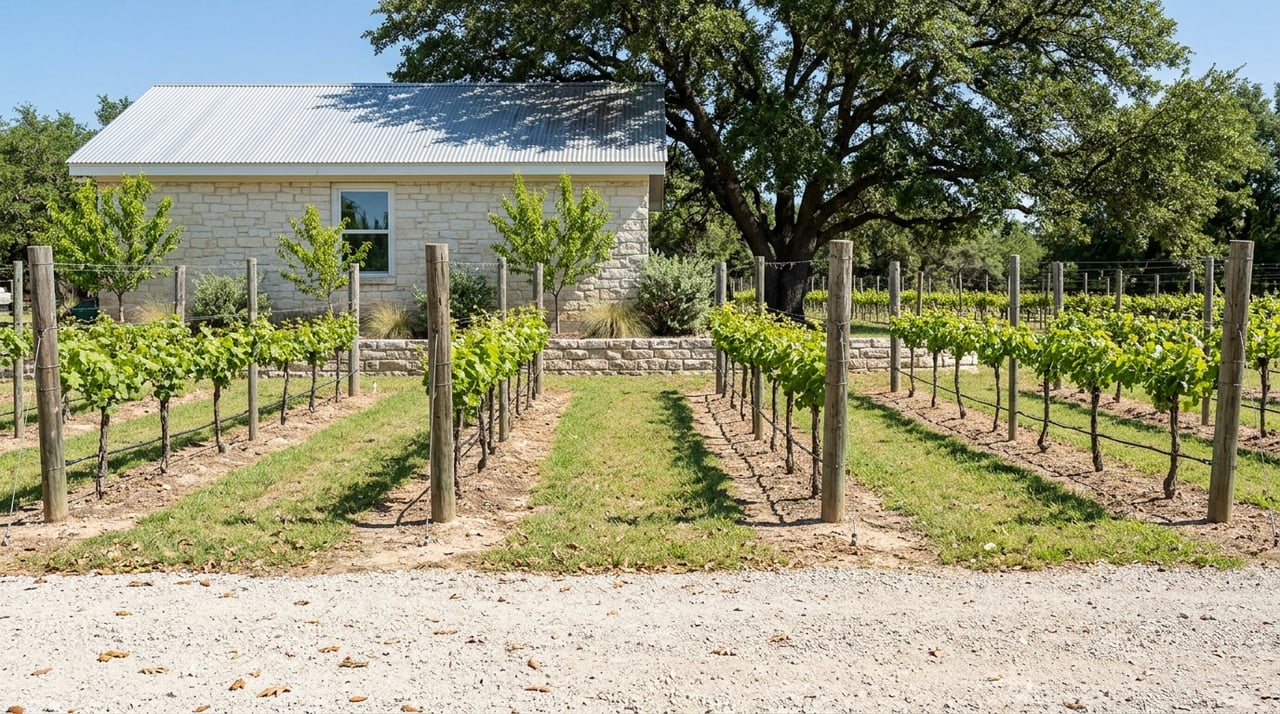
Grapes can be more flexible than peaches on soil type, but they are not flexible about drainage. Texas A&M’s Texas wine vineyard guidance says vines may grow in a range of soils, yet vineyard soils must be well drained.
That means buyers should pay close attention to internal drainage, soil depth, and any tendency for water to stand after rain. A parcel with heavy soil can still be workable in some cases, but only if drainage and root-zone conditions support healthy vines.
Texas A&M’s general grape production practices provide one of the most useful buyer metrics in this entire process: plant no more than one acre of vineyard per 5 gallons per minute of well capacity.
That rule of thumb can quickly reshape your search. A tract may have enough room for a 20-acre vineyard on paper, but if the well capacity does not support it, the productive footprint could be much smaller.
Grapevines are a perennial crop with an expected productive life of about 20 years. That makes the initial land choice especially important.
You are not just asking whether the property works this year. You are asking whether it can support a multi-year capital investment with enough water, access, utility support, and site stability to justify planting.
Before focusing on aesthetics or improvements, pull the soil data. The NRCS Web Soil Survey resource gives you access to official soil-survey information and custom parcel reports.
This is one of the best early screens for drainage, pH, salinity, and overall site fit. It will not answer every question, but it can help you eliminate weak candidates before investing in deeper analysis.
After the mapping stage, move into testing. The Texas A&M Soil, Water and Forage Testing Laboratory is designed for research-based analysis of soil, plant tissue, forage, and non-drinking water.
For orchard or vineyard land, this step is critical. You want real data on soil chemistry and water quality before you assume a tract can support perennial fruit.
Stonewall County has a local Texas A&M AgriLife Extension office in Aspermont. For county-specific conditions, that is a smart starting point.
A buyer should also consider consulting with a soil professional and a water or well specialist. Together, those experts can help verify whether a tract has the well yield, water quality, and site characteristics needed for peaches or grapes.
In Stonewall County, production is only part of the equation. If your plan includes direct fruit sales, a vineyard brand, or any kind of visitor-facing concept, you need to think beyond the vines or trees.
The county’s farm profile suggests direct-to-consumer sales are not common. That means frontage, route visibility, signage, parking, and overall destination appeal may matter more than they would in an established specialty-fruit corridor.
Transportation also matters. The county’s main corridors include U.S. 83 and U.S. 380, as noted by the TSHA county profile. If your business plan depends on customer visits, deliveries, or equipment movement, access should be part of your buying criteria from day one.
The strongest candidates in Stonewall County will usually combine several practical traits:
On the other hand, some warning signs should push you to slow down:
Buying land for peaches or grapes in Stonewall County can be rewarding, but it works best when you treat the search like a due diligence exercise, not just a lifestyle purchase. The county offers real agricultural potential, yet the margin for error can be narrow when your crop depends on drainage, frost positioning, and dependable irrigation.
If you are comparing tracts, it helps to look at each one through the same lens: topography, soils, water, access, and market fit. That disciplined approach can save you time, money, and years of frustration.
When you want an advisor who understands land, rural due diligence, and the practical questions that shape a better purchase, the team at Marjorie Group is here to help you think through the details with clarity and care.
Stay informed with market trends, tips, and community highlights across Fredericksburg and the Hill Country.

From heritage ranches to distinctive homes—we help you move with purpose.
GET IN TOUCH

ADDRESS 106 S LINCOLN ST FREDERICKSBURG TX 78624